
A report prepared by the Association for Democratic Reforms states that the total tax exemptions received by six national parties during financial years 2006 to 2009 is Rs 510.02 crore. Vicky Nanjappa reports

Jaitley promised the states that they would be fully compensated for any loss of revenue arising from implementation of GST.
Planning Commission, on Thursday, expressed reservations on Kelkar Committee proposal to bring processed foods under excise duty net saying it will badly affect growth in the sector.

The GST Bill, seen as single biggest tax reform in a long time, needs to be ratified by at least 15 state legislatures before the President can notify the GST Council which will decide the new tax rate and other issues
The N K Singh task force on power sector reforms has proposed wide-ranging fiscal measures, including cut in customs duty, abolition of special ad valorem duty and tax holiday to step up investments in a bid to bring down tariffs.

'As our per capita income increases and various demographic segments emerge, the need for various kinds of protection and risk covers will become even more explicit.'
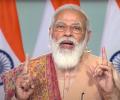
Prime Minister Narendra Modi on Wednesday said that the country's economic growth is picking up pace again and the domestic industry needs to enhance its risk-taking appetite. Noting the recent reforms taken by the government, the Prime Minister said that bringing reforms is a matter of conviction for his government, which is ready to take all risks in the national interest. "We have taken bold decisions. Reforms continued even during pandemic. "The government is doing reforms not out of compulsion but out of conviction," he said while addressing the CII's annual meeting.

The GST Council's agenda includes trimming the number of items in the 28 per cent slab by 75 per cent, easier compliance for assessees and small taxpayers, and a presentation on bringing real estate under GST.
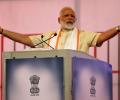
Modi said the Goods and Services Tax has within one year of its launch led to over 70 per cent jump in indirect taxpayer base, demolished check-posts and merged 17 taxes and 23 cesses into one single tax.

Telecom infrastructure player Indus Towers has been largely ignored by investors with occasional bursts of trading when there's news flow. For example, the stock fell from Rs 188 (Jan 1, 2023) to Rs 135 (Jan 27) and then bounced back to Rs 165 in early February as the Government of India (GoI) converted Vodafone Idea's (Vi) debt into equity and Bharti Airtel pushed up its direct stake in Indus to 47.95 per cent. The cash-strapped Vi holds 21 per cent stake in Indus Towers and Indus also has substantial receivables to come in from Vi which is a negative overhang.
Government's reforms agenda in Parliament is in for trouble with its biggest ally Shiv Sena on Monday joining some Opposition parties in declaring resistance to a bill on raising FDI cap in insurance sector from 26 per cent 49 per cent.
The agency has also retained 'stable' outlook for the country's ratings.

The US Citizenship Act 2023 introduced by Congresswoman Linda S nchez creates an earned roadmap to citizenship for all 11 million undocumented immigrants, providing Dreamers, TPS holders, and some farmworkers with an immediate path to citizenship.

Citi, HSBC and UBS etc have already cut their market targets.

GST has been hanging fire with the Opposition Congress yet to come on board

He also took potshots at opposition parties' decision to observing November 8 as a 'Black Day', saying the move displays their faith in cash economy.

Structural changes to government finances could be focus of the Union Budget, says Mihir S Sharma.
A combination of reduced cash intensity, a focused strategy of tax administration and GST is the way to go, say Sakshi Gupta, Tanvi Garg and Abheek Barua.

Pranab Mukherjee's stewardship of the economy will stand out as much for the manner in which he managed controversies as for creating quite a few of them, says A K Bhattacharya.

The government should have mentioned clearly the specific structural reforms that were responsible for the deviation from the fiscal deficit target by half a percentage point, says A K Bhattacharya.

'Modi had not discussed demonetization with me prior to his announcement on 8 November 2016. 'I learnt of it along with the rest of the country. 'I was not surprised when he did not discuss the issue with me prior to making the public announcement. 'It fitted in with his style of making dramatic announcements.' A fascinating excerpt from Pranab Mukherjee's The Presidential Years: 2012-2017.
Unveiling the reform agenda for the Budget, Finance Minister P Chidambaram has said a comprehensive law would be prepared next year to overhaul the Income Tax Act.
.jpg)
The GST will subsume most of the indirect taxes like excise duty and service tax

In a pre-budget meeting with Finance Minister Arun Jaitley, the experts suggested timely implementation of the BJP's election manifesto promises to fix higher support prices. They also favoured a Kissan TV channel, an efficient procurement policy, priority for farm mechanisation and the linking of rivers.

The Centre's revenue from GST registered a decline of 10 per cent in 2017-18 compared to revenue of subsumed taxes in 2016-17.
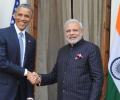
Seeking to further strengthen bilateral economic relations, Prime Minister Narendra Modi on Sunday said India and the US will "restart" discussions on the Social Security Agreement and resume talks on Bilateral Investment Treaty.
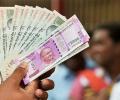
A committee on digitalisation headed by Andhra Pradesh Chief Minister Chandrababu Naidu had in an interim report recommended taxing cash transactions of at least Rs 50,000 to promote digital payments.

The auto industry expects lower taxes and interest rates from Budget 2015.
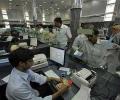
Fiscal deficit, the gap between government's expenditure and revenue, stood at 4.5 per cent in FY14, lower than 4.9 per cent in FY13.

Make In India and the reduction in barriers of trade will potentially create a growth environment.

Once again, tax demands on foreign investors cause worry.
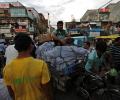
The challenges before the government, he said, is to put public sector banks back on track and continue to operationalise stalled infrastructure projects

Happy at the clear mandate given by voters to the BJP-led NDA, India Inc on Friday exuded confidence that Narendra Modi will initiate bold and decisive policy reforms to promote economic growth.
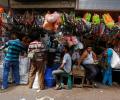
GST stabilisation, DTC implementation and banking reforms are crucial for sustaining high growth for a long period, says Rashesh Shah.

'Are all roads in India privatised? Are governments not playing a role in airports or ports? If they (private players) want to set up lines for a specific requirement, I see no reason to object. It will expand the opportunity and passengers will also benefit.'
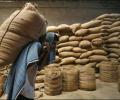
A collapse in global oil prices has unleashed a wave of monetary easing.
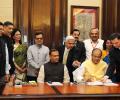
FM is likely to raise tax slabs.
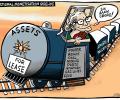
But use of that word -- privatisation -- is not encouraged. This seems to be a classic case of reforms through subtle signals, observes A K Bhattacharya.
Budget may bring exemption for those backed by Indian securities other than shares
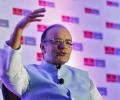
The tax would create a single market in India for the first time.
 © 2026 Rediff.com - Advertise with us - Disclaimer - Privacy Policy - Sitemap - Feedback - About us - Terms of use - Grievances